The Growth Potential (Blog 2 of Listening to Fear series)

Entrepreneurial spirit begins where creativity, opportunity, and business savvy meet. It all starts with an idea. However, even entrepreneurs struggle in achieving their dreams and need guidance. To recap, part 1 of this Blog series “Defining the Dream” laid out the process for attaining your vision through organizing and mapping out an action plan. Now that your vision is clearly defined, let’s continue building on the foundation!

Get Focused – Network Smartly!

There are three key aspects to keep in mind when building your network.

A) Core Network

Defining the Dream encouraged you to share your ideas and connect with like-minded people. A supportive and trusted network is essential to achieving your vision. As your business begins to grow, you will likely encounter a gap in a needed skill set. If your current network is unable to help with bridging this gap – keep networking!

B) Diversify your network to include varying skill sets

The second aspect of networking focuses on connecting with people with a diverse set of skills who can help you. As a Business Strategy Consultant, I’ve supported numerous clients who struggle in this realm. My clients opt to spread themselves too thin by trying to learn every skill necessary, some of which are not their strong suit. Learning these brand new skill sets can ultimately lead to a decrease in your overall productivity.

One client in particular is a Creator/ Developer for an app specializing in Augmented Reality (AR) technology. As my client’s company began to grow, he struggled with meeting priorities outside of his skill set. He needed to switch gears and focus on sales, marketing, content creation, speaking events, as well as continuing to develop his app. After engaging with me and working through his challenges, he realized a fair amount of this work can be delegated. His company – a one person startup – needed to diversify in its’ skill set. Given the demand in technology, we agreed to focus on building his network with Colleges and Universities seeking career defining volunteer opportunities for their students. He was able to provide volunteer opportunities to students in areas such as content creation and marketing, thus allowing him to focus on priorities such as sales, speaking, and developing his app. While it is challenging to let go and share certain responsibilities, this is an essential step in enabling your business to grow organically.

C) Build your network with Game Changers

The Game Changer network consists of people who can refer to your work, speak to your abilities, and can open the door to more opportunities. Typically, your game changer network would encompass former Managers, Directors, Stakeholders, Direct Reports and successful Entrepreneurs. Your Game Changer network will provide you with opportunities to learn from their experiences.

I mentioned the notion of a Game Changer network to another client. He was passionate about using his app to bridge the communication and information gap between doctors/ surgeons and their patients. Located in the USA, my client found immense interest for the usage of his app in many of the nation’s hospitals. He networked with multiple doctors, surgeons and nurses. Unfortunately, he continued to hit roadblocks when it came to selling his app, or having the appropriate channels to fund this new technology. While networking with doctors and surgeons, and providing demos of his app to them were helpful steps in progress, funding continued to remain a challenge. We discussed at length the challenges he was facing, and developed a solution; he needed to grow his Game Changer network. Since healthcare is privatized, we created a plan to grow his network of Game Changers through networking with Health Insurance Companies. In expanding his Game Changer network to Health Insurance Companies, he is putting himself on a path to garner interest and allow for his app to be used in hospitals.

Building and fostering your network is essential to progress, growth and development. Remember to lean on your network to enhance your skill sets. Share your challenges to uncover new strategies for overcoming them. Celebrate your successes to gain new perspectives. Building, growing and fostering your network are essential to success in achieving your vision, personally and professionally. Focusing on the key networking areas can help you achieve and maintain success in your career progression and business.



Marketing Yourself (Blog 3 of The 21st Century Business Analyst series)

Surviving in a downturn economy as an Entrepreneur and a Business Analyst can be exhausting. The constant networking and engagement with the community may seem, in itself, like a full-time job. When the economy begins to shrink, and employment becomes increasingly competitive, it is more important than ever to continue to market yourself. Engaging in networking allows you to remain present in your connections’ minds.

Here are my tips for marketing yourself:

  1. Professional Image

Professional image is key. However, in present times, a professional image can be both very powerful and very superficial. Selfies on social media networks are growing more than ever. Many people have created and maintained their image through direct social media channels. They are in charge and continue to promote a specific image that helps identify their lifestyle. Selfies portray an image that is likely superficial; often depicting an image of a lavish and phenomenal lifestyle. We, as viewers, are not privy to see the life behind the selfies. We do not see their obstacles, their failures, their pitfalls. Thus, we are unable to see what makes them relatable to us. Too often, these types of images portray a fantasy lifestyle. When creating and maintaining your professional image, superficiality is not a trait that should follow you professionally. How do you build a credible and professional image?

a) Be Genuine and Authentic

Through your networking endeavours, remember to be genuine and authentic; there is only one unique you in this world. There is only one person who is you, and though you may meet others with similar experiences, you do not have the same experiences. Learn from each other. The more genuine you are to yourself and share your authentic experiences, the more you are likely to surround yourself with positive people who will support you and help you achieve your goals.

b) Showcase Your Integrity

When you hand-in a deliverable, think of it as your stamp of integrity. As an Entrepreneur, a consultant, or an employee at an organization, this work still defines you. If you created the deliverable, or contributed to it, this work still has your name on it, in some way, shape, or form. Own it. The work that you produce and put in at the start will determine how you will grow and progress in your career. Your integrity can reveal itself in all aspects of life. From your interactions with colleagues, to purchasing a coffee; treat everyone with integrity. Carry it around with you. Your actions define you and are the most visible to your network. Treat everyone with class and dignity, as your integrity is the foundation of a professional image.

c) Be Courageous

Be enthusiastic, be brave. “Courageous” sums it up. You are going to be put into situations where you cannot hide. You may be forced to share your thoughts in a meeting, or at networking events. Break out of your shell and allow yourself to shine. Take chances and embrace the challenges that come your way.

2. Know Your Audience

When building and maintaining your network; know your audience. This concept closely relates to “developing your elevator pitch.” Use your storytelling ability to develop your elevator pitch and share it with your audience.

a) Developing Your Pitch and Modify

When developing your elevator pitch, remember to keep it flexible and tailor it to the audience. Each elevator pitch that you create should emphasize your purpose for attending networking opportunities. Are you growing your network? Are you pitching an idea? Make sure your purpose is clear to your audience. For example, as a Business Analyst, your pitch may encompass skills specific to your profession. However, your pitch may not be relevant if you attend different networking events. You may not always be at a BA event, you may be at an Entrepreneurial event preparing to share your ideas or grow your network and make connections with people from varying professions. How do you stay relatable? Fine tune your elevator pitch and tailor it to the networking events that you attend. Ensure that you emphasize the 5 Ws and How. Find that hook to get your audience engaged with you.

3. Seek New Challenges through Professional Development

Keep yourself relevant! The economical market is an ever-evolving cycle. Competition will always be a reality. Keep yourself engaged and relevant by seeking new challenges in your downtime. If you happen to be in-between contracts, or you have some downtime at work, keep yourself motivated. Challenge yourself; learn and grow. Professional development can encompass a variety of avenues: getting certified, networking with people, meeting up for coffee, etc. Sharing experiences and learning from other experiences is a form of professional development. If you happen to have a connection who owns a small business and was able to grow, this is the perfect opportunity to learn from their successes and failures. Personally, I have found that the biggest pieces of knowledge gained is through meeting and talking with people.  Learning about other experiences allow us to gain perspective, and we may even be able to apply some lessons to our own life. We may be able to overcome our own obstacles through learning about the hardships of others.

My professional development accomplishment of 2016 – 2017 included growing professionally with the help of a mentor. He identified one of my greatest challenges: taking risks. He mentioned that I enjoy structure in my life. He was right, as I realized that unconsciously, I did enjoy structure. I drove the same route to work, I had a structured routine to get ready in the morning, etc. I enjoyed my comfort zone. My journey to take risks began very small, for example, taking a different route into work, or making small changes around the house to get me out of my routine.

Given my previous blogs, you already know that I am the type of person to have many ideas and thoughts at any given time. My challenge was trying to find an avenue to share my ideas. As I became more comfortable with the changes in my routine, my mentor added more challenging risks. I needed to begin publishing my ideas on a public forum (i.e. blogs) and began sharing my ideas through different speaking engagements. Little by little, he added new challenges to get me to break out of my shell and work on my confidence. A great mentor will find that comfort zone and push you to challenge yourself a bit further every day. That’s how you are able to grow and take on amazing opportunities.

In conclusion to this blog series: The 21st Century Business Analyst

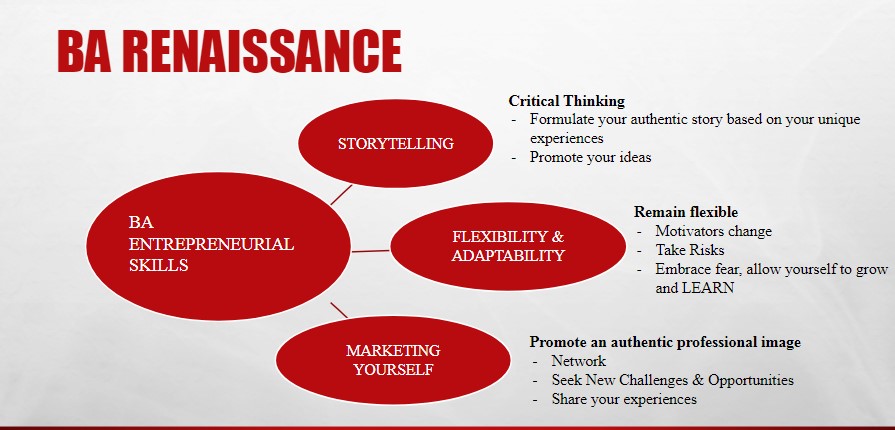
Your entrepreneurial skills are skills that you already have. They are storytelling and critical thinking to formulate your authentic story. Again, there is only one you in this world—own it, promote it, be confident in who you are.

Conclusion

Flexibility & Adaptability (Blog 2 of The 21st Century Business Analyst series)

As Business Analysts, we are required to be very flexible and adaptable in our environment. Our environment can include clients, motivators, opportunities, deliverables, and our overall space. In competitive markets and fluctuating economies, clients are constantly faced with competing and changing priorities. The very nature of our work is to implement change, whether through implementing new processes, technology, strategic direction, etc.  As such, Business Analysts must harness their skills in flexibility and quickly change their priorities (such as deliverables) to meet their client’s needs. I’d like to introduce 3 concepts to help Business Analysts continue to remain flexible & adaptable.

  1. Changing Priorities

Have you ever been in a situation where you’ve been working on a deliverable for a couple of months? Have you had your Project Manager, or Client approach you to inform you that priorities have changed, and the deliverable you have been working on for months is no longer required? We have all been there. It’s quite the frustrating experience. However, as opposed to giving into that frustration, it might be best to leverage the power of perception instead. For example, in this situation, are you going to be the type of person to say “this is months of hard work wasted” or are you going to say “this is possible work and documentation that another BA can leverage”. Or perhaps the company can also leverage this work in a future roadmap. This scenario is important as it highlights the nature of our work. As Business Analysts, we are going to be in environments with changing priorities. How we handle ourselves in these situations all work toward our professional image. We need to be conscious of the image that we put forward. Ideally, we would like to present ourselves in all situations with class, dignity and integrity. When frustrations arise due to changing priorities, it is important to learn to let the deliverables go.

In a downturn economy, remaining flexible can also include re-evaluating your motivators. As organizations change priorities, they can also choose to change people. An extreme situation such as a lay off, may present a catalyst for this re-evaluation to occur.

2. Resilience 

Resilience – Allow yourself to grow.

We’ve all experienced difficult challenges in some way, shape or form. It is through experiencing these challenges that we are able to increase our resiliency. Resilience is essential to success, in our personal and professional life. It is often a quiet skill that is most sought after. Increasing your resilience can also lead to a tangible and desirable skill; being resourceful. Being resourceful in this sense can be defined as having the ability to find quick and clever ways to overcome difficulties. Many of us have experienced situations that have increased our resilience. Especially in a downturn economy, we all know someone, or have experienced a lay off firsthand. In these difficult times, remaining flexible is key.  Flexibility in your motivators can include your career path in this sense. For example, if you have been laid off as an employee, in order to stay competitive, you may have had to switch motivators and become a Business Consultant. Changing motivators allows you to take new risks. Risk taking is a fear that many of us share. We are often faced with the questions of “Am I good enough?” “Will I fail?” These fears tend to manifest as our excuses for not trying; “I don’t have time”, “I don’t have money to invest in this”, “I can’t do this because…”. We have all been there, and this is a difficult habit to break. However, the key to resilience, is to break this habit and try. Afterall, if you are afraid to start a new challenge, chances are it is the right challenge for you to grow.

Another topic I want to cover, is conquering our fear of rejection. Many of us have a fear of hearing the word “no.” And “no” is not that powerful of a word, it has as much power as you enable it to have over you. “No” could be an opportunity, as it is likely to be followed up with the question “why?”. If you happen to pitch an idea to someone, and they respond with “no, why?” this is your time to speak up and convince them; engage your critical thinking skills and pitch your idea. That’s how you become an entrepreneur.

3. Resourceful

Resourceful –  Having the ability to find quick and clever ways to overcome difficulties.

The next skill I want to focus on that will help Business Analysts remain flexible and adaptable; be resourceful. Many employees and consultants demonstrate value in their roles through demonstrating their resourceful skills. In the definition provided above, “Resourceful” is described as a skill to think of clever ways to overcome challenges. If you happen to have been laid off, or your contract ends, be resourceful! Reach out to your network, ask if they know anyone for you to connect with. People genuinely want to help other people, you just need to allow them to help you. One of the lessons I have learned from others, is that there is no self-made person. People help each other achieve successes. If you have a goal, or an idea that you would like to explore, the best thing you can do is share that within your network of trusted and like-minded contacts. If you are vocal enough about what you would like to achieve, people will help you achieve that goal. But like anything, it takes hard work and risks.

Risks – The starting point; it all begins with an idea.

Taking risk is key, not only to professional growth, but also on the road to success. And really, it all begins with an idea. It’s alright to have an idea, and not pursue anything from it. It’s alright to have that choice. However, there are some of us out there who have an idea, and it happens to always be sitting at the back of our mind. If you are passionate about an idea, but too afraid to take a risk and get started, it may be best to think about the Minimum Viable Product (MVP). Assess if there is an appetite for your idea in the market. If you are able to get people interested or “hooked”, it might be valuable to investigate if anyone has had a similar idea to yours. Sharing ideas and experiences with like-minded people will help you overcome your fear. Allow yourself to learn and grow from others. Try to turn a “no” into a potential “yes”, because it can be done. This can be achieved through your confidence, your passion, your approach, your flexibility, your adaptability, and your critical thinking. These are all skills that BAs have in our back pocket, and these skills come the most naturally to us than any other profession.

I’d like to share a story that encompasses all of the skills mentioned above.  In grade 2, I had my own bookmark company. In the age of Scholastic book fairs, I remember kids paying $5 at most for a new bookmark. At that time, my motivator was candy. I thought “if I make my own money, I can buy my own candy.” A simple goal, with a simple idea. I decided to make my own bookmarks and sell them at 5-10 cents each. I went door to door (that is to say, I went to all of my friend’s houses who lived on my street) around dinner time. Dinner time, as we all know, isn’t the best time to get sales. Immediately, I had an idea, ” I need to think bigger”. I went to my room and found an old art supply kit shaped like a briefcase. I dumped out the art supplies and filled the compartments with bookmarks (according to size and theme), and took it to school with me the next day. I tried selling my bookmarks during recess to no avail. After recess, I returned to class, ready to give up on my endeavour. Almost immediately, the teacher had to step out of class briefly. While she was gone, everyone approached my desk wanting to buy bookmarks! I knew, now was not the time to sell bookmarks, however, I knew I needed to sell my bookmarks! What was I going to do with 200 bookmarks for myself?

I popped open my briefcase and quickly completed some transactions, but I wasn’t quick enough. The teacher had returned to the classroom to empty seats and children surrounded around my desk. Needless to say, she was not impressed. That day, I got my briefcase (with my bookmarks and profit) confiscated. I also got a stern lecture from my teacher (outside of the classroom, so other students knew it was serious).

After the embarrassing lecture, I went back to school the very next day. And the day after that, and the day after that. How fearless are we, as children, to have an idea and do it? How fearless are we, to shrug off the lecture and opinion of others, and show up the very next day? Skills like defining motivators, resilience and resourcefulness are often learned at a young age. The biggest lessons we learn are at a young age. We tend to miss applying them to our career when we grow up.


Storytelling- Unlocking Your Entrepreneurial Skills (Blog 1 of The 21st Century Business Analyst series)

Importance of the Big Picture

The concept of Storytelling stems from the question “How important is the big picture?” As a Business Analyst, in order for me do my job effectively and successfully, I need to see the big picture. I realized this more than ever when I happened to be on a project site, and on the first day my project team was given a two page handout of business requirements. Upon analyzing the pages, it was clear that there were audit and compliance requirements. But we were still left with unanswered questions, like why was the current system failing? Who is auditing this company? What problems are occurring and when? The business did a great job of providing my project team with a window into their issues, but any effective BA will tell you that we need to see the house to understand what repairs are needed.

Critical and analytical thinking are absolutely key in Storytelling, both when you’re formulating your story and defining the big picture. Think about where you leverage your critical thinking skills in your career. From a Business Analyst or CEO, to a Lawyer or Juror, to a Teacher or Student, we are all accessing our critical thinking abilities. As BA’s, we engage in critical thinking in meetings with stakeholders for requirements elicitation, and during process building when we are identifying and mapping sustainable processes (just to name a few examples). Your goal as a project team is to save that organization money, and ensure your project is efficient, on time and on budget. The image below demonstrates the path of critical thinking, with the final box highlighting the deliverable:

Critical Thinking

Thus, critical thinking can be broken down into the 5 W’s and the How. Believe me, when they taught you this in grade school, you were being set up for success because you leverage these skills throughout your whole life.

Networking – Telling the Story of You

Now that we have a basis for critical thinking, we can leverage what we know in other areas of our lives. When do we practice storytelling? You can leverage this model when it comes to maintaining and building your network. For those of you who have attended networking events, people you met have likely asked you about your back story: who you are, where you came from, what made you interested in your career. You are already leveraging your analytical and critical thinking skills when you tell the story of you. Whether you are a networking veteran, or completely new to this concept, it is best to always work on, and craft your elevator pitch. Your experiences, your career objectives, your story all work together in promoting your authentic self. Furthermore, networking is how you promote your professional image; it’s not only what you say about yourself, it’s also how you present yourself.

Others can also contribute to your story through references and shared experiences. Therefore, our stories, written by our experiences and input from others ultimately become the badges that we wear. With this in mind, continue to formulate your authentic story based on your unique experiences.

Ideas – Applying Your Critical Thinking Skills to Promote Your Ideas

Now that we’ve got a grasp on the basics of critical thinking and how we can apply it to our authentic story, let’s focus on leveraging these skills to promote your ideas. If you have an idea that you believe in, and your goal is to turn it into a business, or even a side hustle to eventually grow into a business, you could use this critical thinking model to pursue them. This is your time to craft the story of your idea. For example, if you are interested in developing an app, this is the perfect time to use your storytelling ability to craft the story of your app. What is this app used for? Where did you get this idea? When would your target audience use this app? Why and How? Crafting an authentic story around your idea is a great introduction to generate interest and keep people hooked.By leveraging the storytelling ability, you are able to create a pitch. Thus, your model will resemble the image below:

Pitch for Idea

As mentioned in my blog “Defining the Dream” the concept of storytelling is closely related to crafting and creating your selling point for your vision. Using your storytelling abilities will help you grow your network and enable you to connect with like-minded people. Storytelling will also enable you to create your pitch to sell your idea. Once your vision and dream is defined for yourself, then you can craft the story.


Defining the Dream (Blog 1 of Listening to Fear series)

Do you ever feel as if you are a spectator in your own life? Is your mantra “I’ll get to it tomorrow”? Are your big goals frustrating to achieve because you simply do not know where and how to start? As an Entrepreneur, and a perfectionist, the scenario above is all too familiar to me. If any of these sound familiar, you may be suffering from analysis paralysis.

Many Entrepreneurs start their dream career with the grand scale vision already formed. We often begin our journey with the desired end state in mind. Thus, we tend to suffer from the fear of getting started. Listening to your personal fear on getting started can be a double-edged sword; you ultimately have two options:

  1. Stay in your state of fear and paralysis, and hope that tomorrow is another day

OR

2. Harness the power of fear and embrace it as a motivator

If you’re struggling on where to begin, leverage the tips below to lay the foundation of your journey:

  1. Defining the Dream

The major step to success is having a clear vision of what you want to achieve. Share your vision with trusted and positive people in your network. The initial conversations around your vision will help you determine if there is an appetite for your idea or business. Sharing your vision is particularly helpful when it comes to holding yourself accountable (i.e. Saying you will achieve a task, and actually achieving that task).  Keep in mind that people genuinely want to help each other out. If you are able to clearly articulate your vision, you’ll likely attract people who want to help you succeed on your journey.

2. Break Down the Vision into Smaller, Attainable Goals

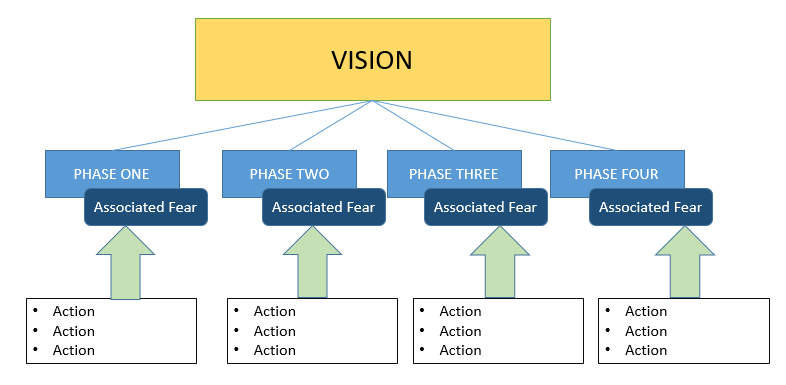
It’s great to dream big, but let’s face it, the big picture is daunting and paralyzing. Breaking your vision into smaller pieces will make getting started easier. If fear is your primary reason for not trying, group your vision into phases and related fears. Under each phase, structure attainable and achievable action items that will work toward accomplishing the related phase, as well as conquering your associated fear head on. If you happen to be a visual person like me, the diagram below should help illustrate the framework:

Vision map

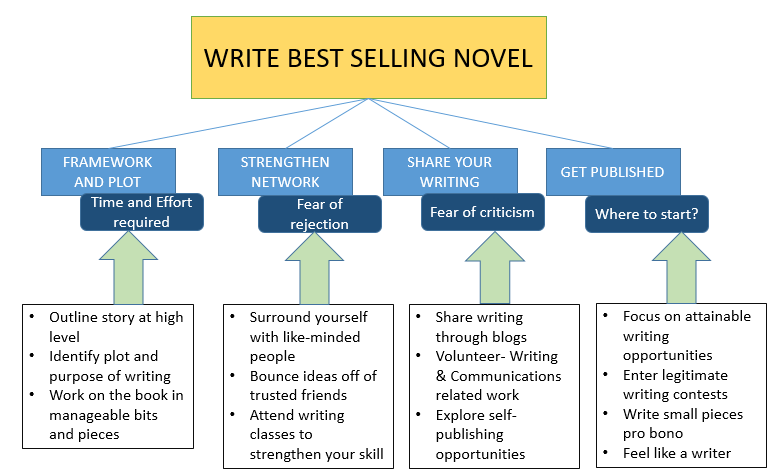
One of my goals is to write a best-selling novel. That dream in itself is pretty daunting; with the time and effort involved as well as other fears that I am currently trying to overcome. Using the diagram above, I was able to breakdown my vision into an attainable and structured roadmap, or to put simply, a plan of action:

Novel roadmap

Now that you’ve got a plan of action in place, it’s time to focus on mitigating your fears.

3.Start Before You’re Ready

From this perfectionist’s point of view, start before you’re ready! If you wait until you are ready, or for when you feel ready, you will be waiting for a very long time as you will never BE ready. You can plan, and mitigate risks and failures to the absolute best of your abilities, but there will always be a reason to stop you from getting started. What you need to focus on, is becoming the reason to get started. Failure is inevitable – find out what your most crippling fears are and find ways to overcome them on a day-to-day basis. For example, many people suffer from a fear of public speaking. In this situation, the logical way of overcoming this fear would be to engage in opportunities to speak up more. There are probably a thousand and one reasons not to start, but there’s one question to ask yourself that will help you start; “Will I regret not attempting this in my lifetime?” If the answer is yes, do yourself a favour and get started!

4. Stop Being a Critic – Give Yourself the Gift of Constructive Criticism

You’ve got a plan and a vision in mind. Surrounding yourself with like-minded and positive people will keep you focused and committed to striving toward your vision. Your network will be a source of inspiration and support on your journey. Be patient and kind to yourself, as you are laying the foundation for success – it won’t happen overnight. If you happen to fall into the trap of becoming your own worst enemy by being overly critical of yourself, break the cycle. In our professional careers, constructive criticism and feedback is valuable in encouraging professional growth. If you have ever provided constructive feedback to your colleagues, employees, even friends, you’ve likely done so in an open, collaborative and polite manner. You’ve likely had constructive feedback and criticism shared to you to help in your career progression.  Take a lesson from this – stop being a critic of yourself, and share constructive feedback with yourself. We are so willing to foster an environment of collaboration and trust with our colleagues, yet we come down hard on ourselves. Be your own champion. Instead of thinking “I should’ve done that better”, change your perspective and ask yourself “how can I do this differently next time?” This approach will help you learn and improve, and will ultimately break the cycle of negative thinking that can stall your progress.

As human beings, we are meant to grow, adapt, mature, change and survive. Fear is a sign of evolution and resilience, ultimately it is growth. We are resilient and capable of learning through action, not inaction. The clock is ticking down for all of us. Given this obvious fact, I want to reiterate the question “Will I regret not attempting this in my lifetime?” If your answer is yes, start now. Don’t continue being the spectator in your own life.

For helpful hints on forming your vision further, check out my blog: Storytelling (to be released during the week of March 20). This blog will help you leverage your critical thinking skills and craft your idea into a pitch.

Follow up your progress from this blog post with “The Growth Potential” to be released at the end of Q2, beginning of Q3 2017.


Introducing New Thought Leadership Series

Happy 2017 Everyone!

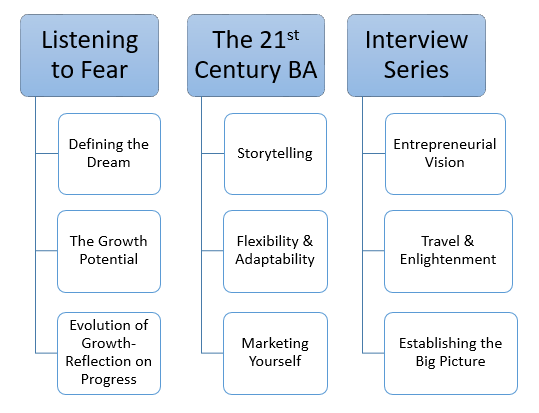
It’s a New Year, which means new goals to achieve! VK Inc is no exception! My goal is to continue to inspire and motivate everyone to become the best version of themselves. I am proud to introduce a new and innovative approach to thought leadership and blogging. VK Inc will continue to share thought leadership, ideas and innovative thinking through a new format- Blogging Series. Three broad topics will be introduced this year, with a series of 3 follow-up blogs to these respective topics. The 1st series is called “Listening to Fear”, the 2nd series is primarily based around Unlocking your Entrepreneurial Skills, and the 3rd series will focus on sharing experiences through interviews.

capture

Through introducing these structured blogs, I’m hoping to provide helpful insight and hopefully encourage you to start your own journey. Each blog will build on top of the previous one, making it easier and more manageable to follow along and measure your success. The first blog(s) will be released in Q1, the second in Q2 (that way you’ve got time to lay down the foundation after reading the first blog), the third will be released in Q4.

Listening to Fear – Objective: We all have a goal, or an idea in the back of our mind that has been silenced due to fear. I am hoping to help everyone make sense of this fear, and ensure growth along the way.

The 21st Century BA – Objective: I recently spoke at the Calgary IIBA Event about leveraging your Business Analysis Skills into Entrepreneurial Skills.  These topics are not exclusive to Business Analysts, as everyone possesses these skills. I am going to expand further on these skills, and possibly help you achieve your goals for 2017. This series will tie in closely with the Listening to Fear series.

Interview Series – Objective: I am proud to introduce my latest endeavour; the Interview Series! Do you ever feel like others have found the secret to life and achieved their dreams? How did they get there? What struggles did they face? Where did they start? This series is meant to share stories and experiences from people who have inspired me, personally. As mentioned in a previous post, sharing experiences and learning from each other are essential to learning and professional growth. Please join me in my journey of bringing empathy back into this world.

Womens’ Strategy Sessions – Update

First of all, I want to deeply thank everyone who was able to attend the very first strategy session on December 7. Thanks for braving the brutal cold! We look forward to hosting more sessions!

What we learned: Though we are a group of quite diverse women with varying backgrounds, our similarities are astounding. From the varied professional women who attended, we were able to share our long-term vision for ourselves. The next piece is breaking down that vision into more attainable goals that will enable us to achieve our vision. We will continue these sessions and our journey, together.

We shared our experiences and realized parallels between the paths that we have chosen. There is much to be said about the value of “Storytelling;” it is a key component to thought leadership. We’ve all been through some rough times, dealing with insecurities, and life in general. Storytelling is allowing a person to recall their journey, and sharing these experiences with others who are willing to learn and listen. Ultimately, storytelling helps to ensure that there is a profound connection established by the person who is sharing, and their audience.

And isn’t that what we are inevitably seeking? Connections and interactions in some form, enable us to be human. Whether it is about building our network within our professional city, or maintaining connections through former colleagues, friends and family. Our network becomes our strength, and our story becomes a badge that we wear.

What’s next? Keep up the momentum! When we departed for the night, I think we all felt inspired and connected with each other. Through shared experiences, values, and goals, we were able to inspire each other to reach the next level. We shared ideas from our previous experiences to help inspire us to become more confident, brave and fearless in our daily interactions. Even better, these strategy sessions seem to be growing as I’ve had interest from others in joining the group. I’m happy to continue growing these sessions and inspiring others to help achieve their goals.


Introducing Women’s Strategy Sessions — VK Inc

VK Inc is proud to introduce and develop Women’s Strategy Sessions! Beginning December 7, 2016. About: The Women’s Strategy Sessions are designed to bring together a group of like-minded, independent, strong women. We are designed to promote thought leadership, motivation, innovation, leadership, resilience, etc within the Calgary community. The Journey: The idea to form a […]

via Introducing Women’s Strategy Sessions — VK Inc